At first glance, a pickleball might seem like the simplest piece of equipment in the game. It is lightweight, plastic, and filled with holes. Yet behind that simple appearance lies a surprising amount of engineering. Every hole, curve, and material choice plays a role in how the ball moves through the air, bounces off the court, and reacts to spin.
Precision drilled pickleball balls are the result of careful design and testing. Manufacturers use scientific principles from aerodynamics, materials engineering, and impact physics to create balls that deliver consistent flight and reliable performance.
Understanding the science behind these balls reveals why high quality construction makes such a difference on the court.
Why Pickleball Balls Have Holes
The holes in a pickleball are not just decorative. They serve a critical aerodynamic purpose.
When a ball moves through the air, it encounters resistance from the surrounding air molecules. Without holes, a smooth plastic sphere would travel too fast and would be difficult to control. The holes help reduce air pressure buildup around the ball and create a more predictable flight path.
The number, size, and placement of these holes determine how the ball behaves during play. Outdoor balls often use forty holes, while indoor balls may have larger but fewer holes. These differences influence wind resistance, spin response, and bounce consistency.
Precision drilling ensures that every hole contributes to balanced airflow around the ball.
The Role of Aerodynamics in Ball Flight
When a pickleball is struck, it immediately begins interacting with the air around it. The air flowing through and around the holes creates drag, which slows the ball and stabilizes its flight.
If the holes are unevenly spaced or poorly drilled, the ball can wobble in flight. This wobble is caused by uneven airflow and slight imbalances in weight distribution.
Precision drilled balls maintain symmetry across the entire surface. This symmetry helps the ball travel smoothly through the air without unpredictable movement.
For players, this means more reliable shots and better accuracy during fast rallies.
Consistent Bounce Through Structural Balance
Bounce consistency is another area where precise engineering matters. When a ball hits the court surface, the plastic shell compresses slightly before springing back into shape.
If the shell thickness varies or the holes are unevenly distributed, the ball may bounce unpredictably. Some shots might jump higher while others stay lower.
Precision drilled balls maintain even structural integrity across the entire shell. The uniform design distributes impact forces evenly when the ball contacts the court.
This consistency helps players anticipate how the ball will behave after each bounce, which is essential for timing drives, volleys, and defensive returns.
How Hole Patterns Affect Spin
Spin plays a major role in modern pickleball strategy. Players use topspin to drive the ball downward, backspin to slow it down, and sidespin to create challenging angles.
The hole pattern on a pickleball affects how the air interacts with a spinning ball. When the ball rotates, airflow around the holes creates small pressure differences that influence its trajectory.
Precision drilled holes help maintain predictable spin behavior. Instead of producing erratic movement, the ball responds cleanly to the player’s technique.
This allows skilled players to execute controlled spins that dip, curve, or float exactly as intended.
Durability and Material Science
Precision drilling is only one part of the equation. The plastic material used in high quality pickleball balls is carefully chosen to balance durability and flexibility.
The shell must be strong enough to resist cracking during hard impacts while still remaining flexible enough to produce a lively bounce. Temperature changes also affect plastic behavior, especially during outdoor play.
Manufacturers test different polymer blends to ensure that the ball maintains its shape and performance over many games.
A well engineered ball keeps its structure even after repeated impacts with paddles and court surfaces.
Why Consistency Matters in Competitive Play
In recreational play, minor inconsistencies might go unnoticed. In competitive environments, however, even small variations in ball performance can influence the outcome of a rally.
Professional players rely on predictable ball flight, stable bounce patterns, and reliable spin response. Precision drilling helps ensure that every ball performs nearly identically.
This consistency allows players to trust their technique and focus entirely on strategy and execution.
For tournament play, high quality balls are essential for maintaining fairness and performance standards.
Why the Gatorstrike Quick Strike 40 Is a Great Choice
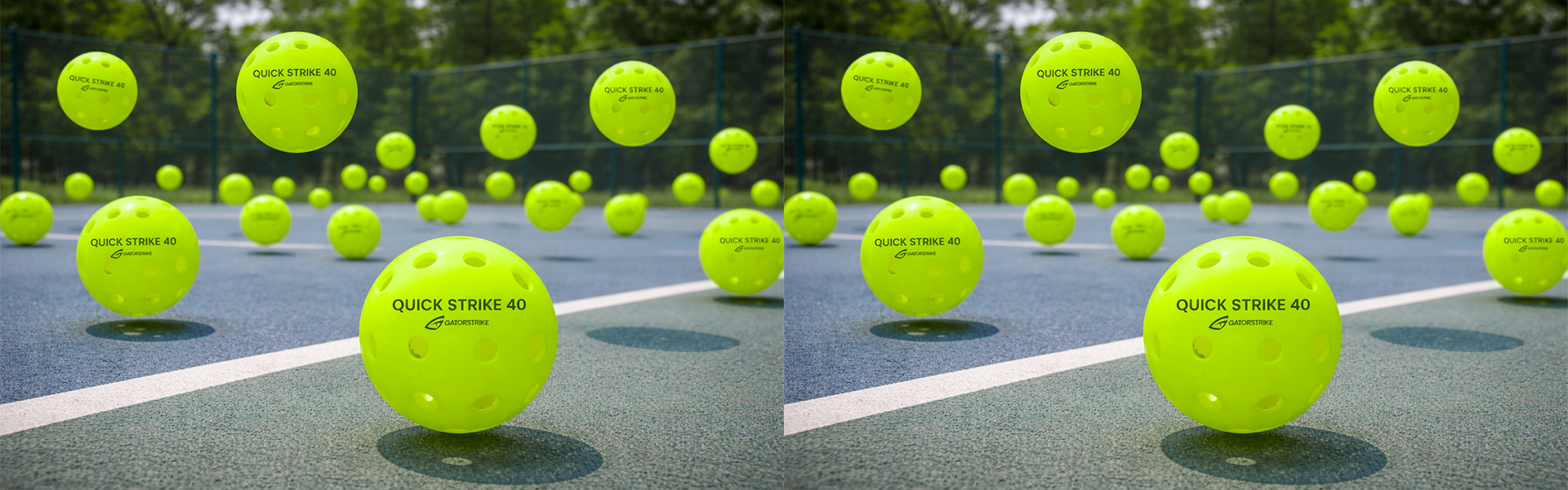
For players who want to experience the benefits of precision drilled design, the Gatorstrike Quick Strike 40 is an excellent option.
This ball features a carefully engineered forty hole pattern designed specifically for outdoor play. The precision drilling ensures balanced airflow around the ball, producing smooth and stable flight even during fast paced rallies.
The durable construction maintains consistent bounce and structural integrity, allowing players to rely on predictable performance throughout long matches. Its design also supports controlled spin response, making it easier for players to execute topspin drives, slices, and strategic placement shots.
All of the scientific principles discussed in this article come together in the Gatorstrike Quick Strike 40. From aerodynamic stability to reliable bounce and durability, it delivers the kind of performance serious players expect.
For anyone looking for a high quality outdoor pickleball that combines engineering precision with dependable playability, the Gatorstrike Quick Strike 40 is a highly recommended choice.