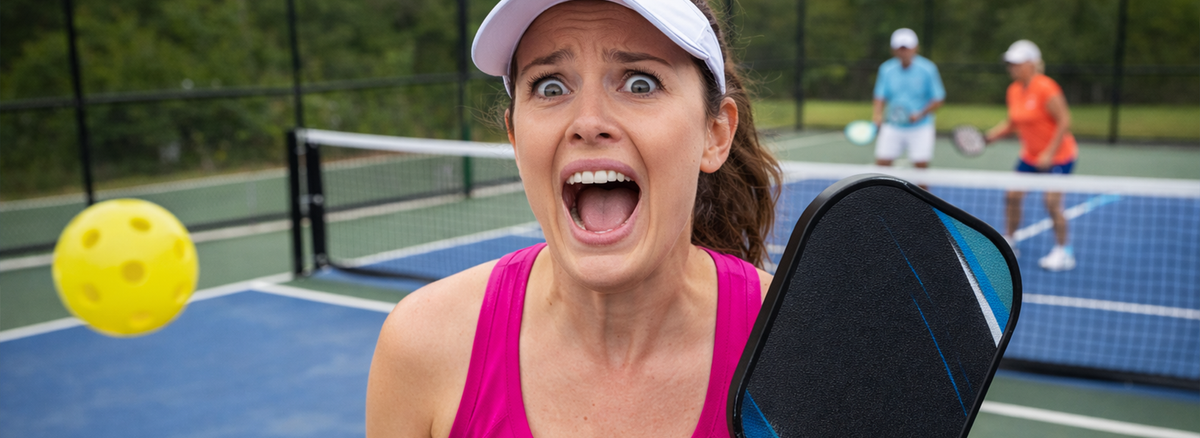
Your first pickleball game will feel fast, loud, and slightly confusing.
The score will sound like a secret code. People will shout “kitchen” with urgency. The ball will bounce in ways that surprise you. And somehow, everyone else will look like they know exactly where to stand.
Take a breath.
That chaos is not a sign you are bad at the game. It is a sign you are entering a sport with its own rhythm, language, and logic. Once you understand what is happening beneath the noise, the court starts to make sense.
Here is how to survive your first pickleball game and actually enjoy it.
Accept That It Will Feel Awkward
Pickleball is deceptively simple. The court is small. The paddle is light. The ball moves slower than a tennis ball.
But the strategy is different from most racket sports, and your instincts may not immediately help you.
New players often struggle with:
-
The double bounce rule
-
Staying out of the kitchen on volleys
-
Knowing when to move forward
-
Keeping the ball low
Research on skill acquisition shows that early performance confusion is normal when rules contradict previous habits. If you have played tennis, you will want to swing big. If you have played Ping-Pong, you will stand too upright and too close.
Instead of fighting that awkward phase, expect it. You are not failing. You are recalibrating.
Learn the Two Rules That Matter Most
There are many rules in pickleball, but two define the structure of your first game.
The Double Bounce Rule
After the serve, the receiving team must let the ball bounce once. Then the serving team must also let the return bounce before hitting it in the air. Only after those two bounces can players volley.
This rule prevents immediate net domination and gives both teams time to move forward.
The Kitchen Rule
The non volley zone, commonly called the kitchen, extends seven feet from the net on both sides. You cannot volley while standing inside it. If your momentum carries you into the kitchen after a volley, that is also a fault.
These two rules shape the flow of the entire sport. If you remember them, you will avoid most beginner mistakes.
Get to the Kitchen Line Quickly
One of the biggest survival tips is positional.
After the serve and return sequence, your goal is to move toward the kitchen line. That is where points are won.
Beginners often stay at the baseline because it feels safer. In reality, that position puts you at a disadvantage. Players at the kitchen can hit sharper angles and apply more pressure.
A simple rule for your first game:
Serve
Return
Let the ball bounce
Then move forward with your partner
Even if you do not execute perfect shots, being in the correct position will instantly improve your chances.
Stop Swinging So Hard
Your natural instinct may be to hit the ball hard to end the point. In pickleball, that usually backfires.
The plastic ball does not respond to power the same way a tennis ball does. Hard swings often send shots long or into the net. More importantly, power is easier to defend than you think on a small court.
Focus on:
-
Controlled swings
-
Keeping the ball low over the net
-
Aiming for open space rather than lines
Advanced data from competitive play shows that many points end because of forced errors, not outright winners. Patience beats panic.
Communicate With Your Partner
If you are playing doubles, communication is not optional.
Say “mine” or “yours” early and clearly. Call out “switch” if you need to trade sides after a wide shot. Encourage each other after mistakes.
First games feel chaotic largely because players hesitate. Two paddles go for the same ball. Or worse, neither does.
Clear, simple communication reduces confusion and builds rhythm quickly.
Do Not Obsess Over the Score
Pickleball scoring can sound complicated at first. You will hear three numbers called before each serve in doubles. The third number indicates which server is serving on that side.
If you lose track, ask. Experienced players are used to helping newcomers with scoring.
During your first game, your focus should be:
Making clean contact
Understanding positioning
Learning the flow
The score matters less than the experience.
Expect Fast Hands at the Net
Once both teams reach the kitchen line, rallies can shift suddenly into quick exchanges. These hand battles feel intense, especially the first time.
The key is to stay balanced.
Keep your paddle up in front of your chest. Bend your knees slightly. Avoid large backswing motions. Short, compact blocks and counters work best in close quarters.
You do not need lightning reflexes. You need readiness and stability.
Laugh at the Mistakes
You will:
Step into the kitchen at the wrong time
Hit the net on a serve
Swing too late on a volley
Forget the score
Everyone has done it. Even advanced players occasionally make the same mistakes.
Pickleball thrives on community energy. Most open play environments are welcoming, especially toward new players. If you approach the game with curiosity rather than self judgment, you will improve much faster.
Confidence grows from repetition, not perfection.
What Happens After the Chaos
Here is the part no one tells you.
Somewhere during that first chaotic game, something clicks.
You win a longer rally with a soft shot at the kitchen. You anticipate a speed up and block it cleanly. You and your partner move forward together without speaking.
The game slows down.
What once felt frantic starts to feel tactical. You begin to see patterns. You understand why players move the way they do.
That shift is why so many people fall in love with pickleball.
Final Thoughts
Your first pickleball game will be messy. It will feel faster than expected and slower than you imagined at the same time.
Surviving it is not about playing perfectly. It is about understanding the structure, moving to the right position, controlling your swings, and embracing the learning curve.
Stay patient. Stay curious. Stay near the kitchen line.
The chaos fades quickly. The enjoyment lasts much longer.