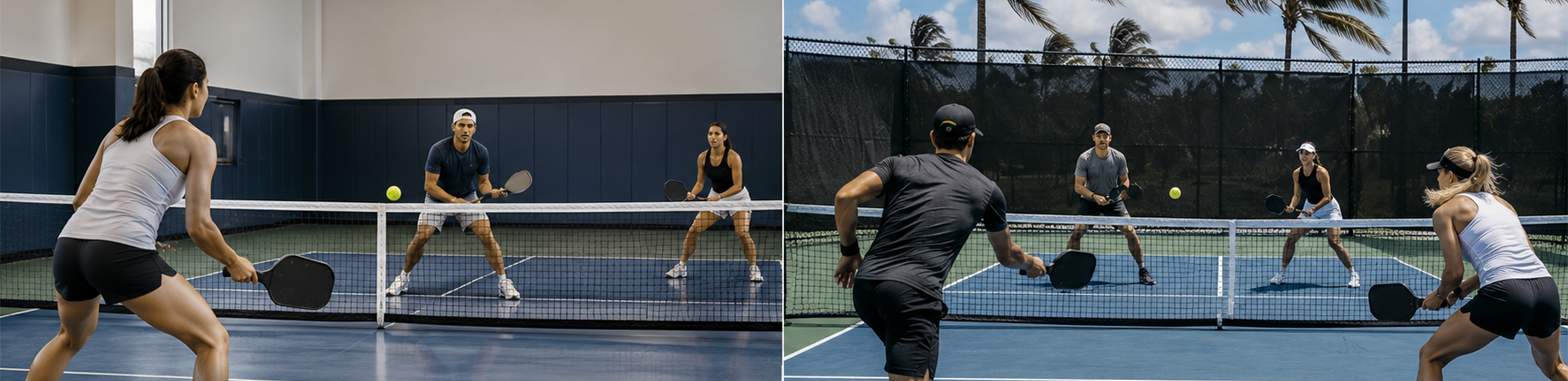
Pickleball may follow the same rules indoors and outdoors, but anyone who regularly plays both versions of the game quickly realizes they feel completely different. Shots that work perfectly inside a gym can suddenly float long outdoors. Fast drives that dominate on outdoor courts may become harder to control indoors. Even movement, timing, and strategy shift depending on the environment.
These differences are not just minor adjustments. Court conditions directly influence ball behavior, player movement, reaction speed, stamina, and decision making. Understanding how indoor and outdoor conditions affect gameplay can help players adapt more quickly, avoid frustration, and become more versatile competitors.
Many players struggle when transitioning between environments because they expect their usual habits to produce the same results everywhere. The reality is that successful players learn how to adjust their game based on conditions rather than fighting against them.
Whether you are stepping into an indoor gym during winter or competing outside on a windy afternoon, learning how the environment changes pickleball can dramatically improve consistency and confidence.
The Biggest Difference Starts With the Ball
One of the most important distinctions between indoor and outdoor pickleball is the ball itself.
Although they may look similar at first glance, indoor and outdoor balls are designed differently to match their playing environments.
Outdoor Pickleballs
Outdoor balls are typically made from harder plastic and contain smaller holes. These balls are built to handle wind resistance and rougher court surfaces.
Because of their construction, outdoor balls tend to:
Move faster through the air
Bounce lower and firmer
Feel heavier during contact
Produce more predictable flight in windy conditions
Require stronger control on drives and speed ups
Outdoor rallies often feel quicker and more aggressive because of the faster pace created by the ball.
Indoor Pickleballs
Indoor balls usually have larger holes and softer plastic construction.
This creates:
Softer bounce characteristics
Slower flight speed
Longer reaction time
Greater emphasis on touch and placement
Less aggressive rebound off the paddle
Indoor games often feel more controlled and finesse oriented compared to outdoor play.
Wind Completely Changes Outdoor Strategy
Wind is arguably the single biggest factor separating indoor and outdoor pickleball.
Even mild wind conditions can influence ball trajectory dramatically. Players quickly learn that controlling depth, spin, and placement becomes much more difficult outdoors.
Serving in Wind
Strong serves become riskier when wind is unpredictable. Many experienced outdoor players prioritize consistency and placement over maximum power.
Dinking in Wind
Soft kitchen play becomes far more delicate outdoors. A slight gust can push a dink too high or too wide unexpectedly.
Lobs Become Dangerous
Lobs can either become brilliant weapons or disastrous mistakes depending on wind direction and strength.
Shot Selection Changes
Outdoor players often simplify their game during difficult conditions. High percentage shots become more valuable than risky winners.
Indoors, players rarely need to worry about environmental interference, which creates a more stable and predictable rhythm.
Court Surfaces Affect Movement and Bounce
Indoor and outdoor courts also differ significantly in surface texture and responsiveness.
Outdoor Courts
Most outdoor pickleball courts use textured hard surfaces similar to tennis courts.
These courts generally create:
Higher friction
Faster wear on shoes and balls
Lower and more consistent bounce
Greater impact stress on joints
Outdoor movement often feels more explosive because players rely heavily on grip and quick directional changes.
Indoor Courts
Indoor pickleball is commonly played on gymnasium floors made from wood or synthetic materials.
Indoor surfaces may feel:
Slightly smoother
Less abrasive
More forgiving on joints
Less predictable with bounce depending on floor quality
Some indoor courts can feel slippery, especially when dust or moisture accumulates on the surface.
Players transitioning between environments often notice immediate changes in footwork confidence and balance.
Lighting Changes Visual Perception
Lighting conditions are another major adjustment factor.
Indoor Lighting
Gym lighting can create shadows, glare, or difficulty tracking high balls near ceilings and overhead fixtures.
Players may struggle with:
Lobs near lights
Visual depth perception
Ball tracking against bright ceilings
However, indoor lighting remains relatively stable throughout matches.
Outdoor Lighting
Outdoor play introduces constantly changing sunlight conditions.
Players may deal with:
Sun glare during serves
Shifting shadows
Difficulty tracking balls at sunset
Cloud coverage changes
Wind combined with sunlight can make outdoor tracking particularly challenging during fast exchanges.
Experienced outdoor players often use strategic positioning to minimize sun exposure during critical points.
Temperature Influences Ball Speed and Stamina
Weather conditions also affect both equipment performance and physical endurance.
Hot Outdoor Conditions
Heat can make outdoor sessions physically demanding very quickly.
Players may experience:
Faster fatigue
Dehydration
Reduced reaction sharpness
Grip issues from sweat
The ball itself may also bounce faster in warmer temperatures.
Cold Outdoor Conditions
Cold weather can make balls feel harder and less responsive. Players often notice reduced control and increased stiffness in their hands and joints.
Indoor Climate Stability
Indoor play typically offers more consistent temperatures, which helps create stable conditions for ball control and physical performance.
This consistency allows players to focus more purely on tactics and execution.
Indoor Pickleball Often Rewards Finesse
Because indoor conditions are more controlled, finesse and touch become particularly important.
Indoor rallies frequently involve:
Longer dink exchanges
More patient point construction
Greater emphasis on placement
More controlled resets
Softer hands at the kitchen line
Without wind disrupting shots, players can execute delicate touch shots more confidently.
This environment rewards precision and consistency over raw power.
Outdoor Pickleball Often Rewards Adaptability
Outdoor play tends to favor players who can adapt quickly to changing conditions.
Successful outdoor players often demonstrate:
Stronger mental flexibility
Better anticipation
More controlled aggression
Improved balance in windy conditions
Higher tolerance for imperfect bounces
Outdoor players frequently become more resilient because they learn to problem solve continuously throughout matches.
Conditions rarely stay perfectly stable for long.
Spin Behaves Differently Indoors and Outdoors
Spin can feel dramatically different depending on the environment.
Outdoors
Wind and harder balls can exaggerate spin movement, especially topspin and slice effects.
However, wind can also reduce predictability.
Indoors
Spin tends to behave more consistently because environmental interference is removed.
Players can rely more confidently on repeatable spin patterns during serves, drops, and passing shots.
Many players feel their spin control improves indoors because conditions are easier to read.
The Mental Side of Indoor and Outdoor Play
Indoor and outdoor pickleball create different psychological challenges.
Indoor Mental Challenges
Because conditions are controlled, players often feel more pressure to execute perfectly. Mistakes stand out more clearly when environmental excuses disappear.
Outdoor Mental Challenges
Outdoor players must accept unpredictability. Wind, sunlight, and odd bounces create situations that cannot always be controlled.
This requires patience and emotional flexibility.
Players who mentally adapt to outdoor variability tend to stay calmer during frustrating conditions.
Adjusting Your Game Between Indoor and Outdoor Play
The best pickleball players are not necessarily specialists in one environment. They are adaptable competitors who adjust quickly.
Tips for Transitioning Outdoors
Use safer margins during windy conditions
Stay lower with shots
Simplify your game when necessary
Prioritize footwork and balance
Hydrate consistently in warm weather
Tips for Transitioning Indoors
Focus more on touch and precision
Be patient during dink exchanges
Use controlled spin placement
Trust predictable ball movement
Adjust to lighting early during warm ups
Small tactical adjustments often make a huge difference in performance.
Which Environment Is Better?
There is no universal answer.
Some players love the controlled rhythm and softer touch of indoor pickleball. Others enjoy the challenge, athleticism, and adaptability required outdoors.
Indoor pickleball offers consistency and cleaner shot execution.
Outdoor pickleball offers variety, environmental challenge, and often a more dynamic pace.
Both environments develop valuable skills that can improve overall gameplay.
Players who experience both versions of the sport usually become more complete competitors over time.
Final Thoughts
Indoor and outdoor pickleball may share the same court dimensions and scoring system, but they create entirely different playing experiences.
Wind, lighting, court surfaces, ball construction, temperature, and environmental conditions all influence how the game feels and how players must respond strategically.
Understanding these differences allows players to adapt instead of becoming frustrated when conditions change. It also deepens appreciation for the complexity and versatility of pickleball itself.
The most successful players are not the ones who demand perfect conditions. They are the players who learn how to adjust, stay composed, and compete confidently no matter where the match takes place.